
 Unofficial fan guide
 Logic-first
 Beginner friendly
 Hard level help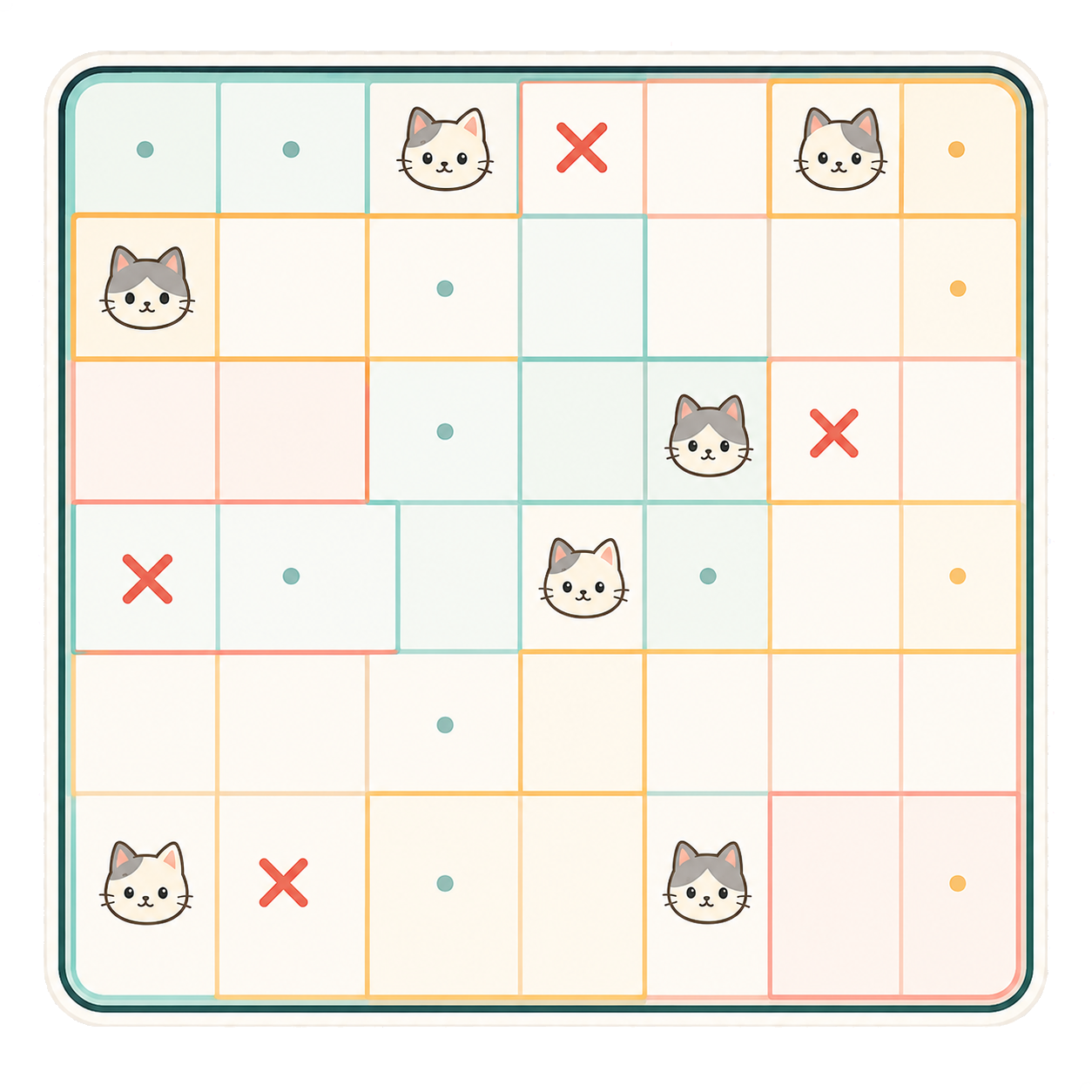
7 Quick Meowdoku Tips Before You Start

Mark impossible cells first
Use X marks to clear obvious no-cells before placing a cat.
Start with small regions
Tiny regions create pressure faster and reveal safe moves.

Use row and column pressure
Scan every line touched by a region before you choose.

Respect no-touching checks
Cats cannot touch, even diagonally, so nearby cells matter.

Avoid emotional guessing
If two cells look possible, pause and find new evidence.

Re-check after every cat
Each placed cat changes rows, columns, and neighbors.

Look for forced singles
When every other cell is crossed out, the last one wins.
Beginner Meowdoku Tips
Master the basics first. For a quick overview, read How to Play Meowdoku, then compare a simple walkthrough like Meowdoku Level 1.

Understand the region rule
Each colored region must contain exactly one cat. Start by treating every region as its own small puzzle.

Remove same row and column cells
If a cat is already in a row or column, mark the other cells in that line as impossible.

Remove touching cells
Cats cannot touch, including diagonally, so nearby cells should become X marks.

Only place when forced
Place a cat only when the logic leaves exactly one valid cell in a region or line.
How to Solve a Meowdoku Level Step by Step
Use this loop whenever a board feels crowded: scan, mark, place only when forced, then update the board before your next move.
- 1
Scan all colored regions
Find the smallest or most restricted regions before committing to any move.
- 2
Mark obvious no-cells
Cross out cells blocked by existing cats, row pressure, column pressure, or neighbor contact.
- 3
Find forced regions
Look for any region where every cell but one has become impossible.
- 4
Update the board immediately
After each cat placement, refresh every affected row, column, region, and neighboring cell.
- 5
Repeat from the smallest region
The cleanest Meowdoku strategy is eliminate, place, update, then scan again.
- 6
Stop when you feel like guessing
A guessing urge usually means one restriction has not been checked yet.
Advanced Meowdoku Strategy for Hard Levels
Hard levels usually need patient elimination rather than a new rule. These patterns help you prove why a cell cannot hold a cat.

Region Pair Logic
When two cells in one region share the same row or column, they can block possibilities in neighboring regions without choosing either cell yet.

Chain Blocking
Follow the impact of one possible cat through touching and line restrictions. If the chain breaks a region, the starting cell is impossible.
Contradiction Check
For a hard level, lightly test one candidate in your head. If it forces two cats into the same row or empties a region, mark it with X.
Common Meowdoku Mistakes
Most mistakes come from moving faster than the board can justify. Use this table as a quick reset when you keep losing hearts.
| Mistake | Why it hurts | Better habit |
|---|---|---|
| Placing cats too early | One lucky placement can hide a later contradiction. | Mark impossible cells until a region is forced. |
| Ignoring touching cells | A corner touch can invalidate a board even when rows and columns look clean. | Check all eight neighboring cells around every cat. |
| Only checking one region | Meowdoku clues often come from how regions pressure each other. | After each move, scan nearby regions and shared lines. |
| Guessing between two cells | A 50/50 guess burns hearts and teaches the wrong habit. | Search for a row, column, region, or touching cell that affects only one option. |
| Forgetting to update marks | Old possibilities stay on the board and make hard levels feel random. | Refresh X marks immediately after every placed cat. |
Placing cats too early
Why it hurts
One lucky placement can hide a later contradiction.
Better habit
Mark impossible cells until a region is forced.
Ignoring touching cells
Why it hurts
A corner touch can invalidate a board even when rows and columns look clean.
Better habit
Check all eight neighboring cells around every cat.
Only checking one region
Why it hurts
Meowdoku clues often come from how regions pressure each other.
Better habit
After each move, scan nearby regions and shared lines.
Guessing between two cells
Why it hurts
A 50/50 guess burns hearts and teaches the wrong habit.
Better habit
Search for a row, column, region, or touching cell that affects only one option.
Forgetting to update marks
Why it hurts
Old possibilities stay on the board and make hard levels feel random.
Better habit
Refresh X marks immediately after every placed cat.
Meowdoku Tips by Player Type
Choose the path that matches how you play today, then come back to the strategy loop when a level gets tricky.
For complete beginners
Learn the basic rules first, then return here for solving habits.
Read How to PlayFor players stuck on one level
Compare the board carefully, starting with a simple walkthrough like Level 1.
Browse Level AnswersFor hard level players
Use level answers to confirm logic paths when a board starts feeling crowded.
View Hard Level HelpFor daily puzzle players
Practice clean marking and no-guess solving on original cat logic boards.
Try Practice ModeNeed More Help?


Meowdoku Tips FAQ
Short answers for the questions players usually ask when they want to improve without spoiling every level.
What is the best Meowdoku tip for beginners?
The best beginner tip is to mark impossible cells before placing cats. X marks make the logic visible and help you spot forced regions without guessing.
Should I guess in Meowdoku?
No. Guessing can cost hearts and makes it harder to learn. If two cells both look possible, check row, column, region, and no-touching restrictions again.
Why do I keep losing hearts in Meowdoku?
Most heart losses come from placing cats too early, missing neighbor contact, or forgetting to update X marks after a move.
How do I solve hard Meowdoku levels?
Hard levels are easier when you scan the smallest regions first, track forced pairs, and stop immediately whenever the next move feels like a guess.
What should I do when two cells both look possible?
Do not choose randomly. Compare how each cell affects nearby touching cells, rows, columns, and neighboring regions until one option creates a contradiction.
Are Meowdoku tips different from level answers?
Yes. Tips teach general solving habits you can reuse on any board, while level answers help you compare or finish a specific level.